Quiz Entry - updated: 2026.07.30
What is the detailed structure of a GSM TDMA frame and burst?
A GSM frame consists of 8 time slots of 577 microseconds each (total frame = 4.615 ms), and each burst contains guard spaces, tail bits, user data, and a training sequence.
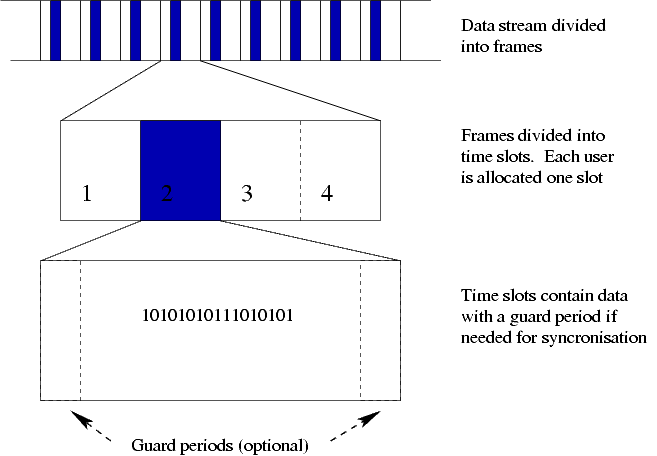
* GSM TDMA frame split into eight burst slots. — Mozzerati, CC BY-SA 3.0, via Wikimedia Commons. *
GSM frame structure:
- Total bandwidth (GSM-900): 124 frequency channels, each 200 kHz wide
- Each channel is divided into 8 time slots (TDMA)
- One time slot = 577 µs = one burst
- One TDMA frame = 8 slots = 4.615 ms
Burst structure (within one 577 µs slot):
| Guard | Tail | User data | S | Training | S | User data | Tail | Guard |
| ~8.25 |  3   |    57     | 1 |    26    | 1 |    57     |  3   | ~8.25 |
The content fields total 148 bits spanning 546.5 µs; the remaining time of the 577 µs slot is the guard period (~8.25 bit-times).
- Guard space — empty time to prevent overlap with adjacent slots (timing uncertainty)
- Tail bits — known bit patterns at both ends to help the receiver synchronize and bound the equalizer
- S — stealing flags — 1 bit on each side of the training sequence; when set, the user-data fields are "stolen" to carry urgent signaling (FACCH) instead of voice
- Training sequence — a known 26-bit pattern in the middle used for channel estimation (the receiver learns the current channel distortion and compensates for it)
- User data — 2 × 57 bits = 114 bits of actual payload per burst
Data rate calculation: 114 useful bits per 4.615 ms frame = ~24.7 kbps raw data rate per time slot. After channel coding overhead, GSM delivers about 13 kbps for voice (using the Full Rate codec).
Go deeper:
 GSM slot & burst structure (Electronics Notes) — field-by-field breakdown of the normal burst (tail / data / training / stealing / guard), plus the access, sync and frequency-correction burst variants.