Quiz Entry - updated: 2026.07.30
What is the difference between channelization codes and scrambling codes in UMTS CDMA?
Channelization codes (OVSF) separate users within the same cell; scrambling codes separate cells (and sectors) from each other. The signal is first spread with OVSF, then scrambled.
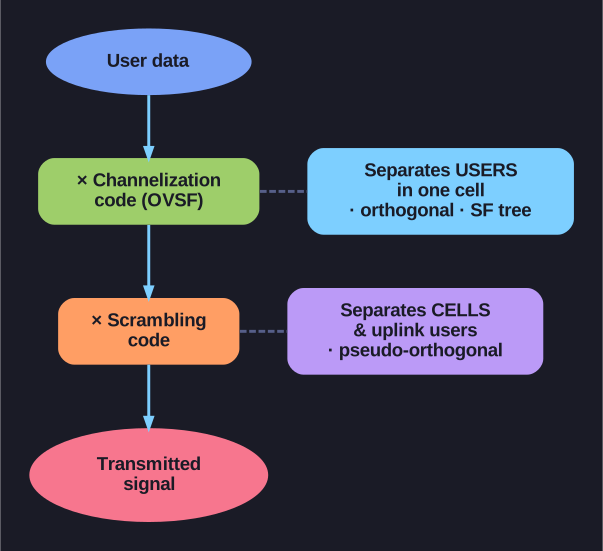
* Spread-then-scramble: OVSF separates users, scrambling separates cells. *
Two-stage process:
User data → × Channelization code (OVSF) → × Scrambling code → Transmitted signal
Channelization codes (OVSF):
- Separate users within one cell/sector
- Perfectly orthogonal — zero cross-correlation → no intra-cell interference
- Generated from the OVSF tree
- Each user gets a unique OVSF code from the same tree
Scrambling codes:
- Separate cells and sectors from each other
- Pseudo-orthogonal (pseudo-random, not perfectly orthogonal) → some residual inter-cell interference
- Each base station sector gets a unique scrambling code
- All OVSF-spread signals from one sector are combined, then multiplied by the sector's scrambling code
Why two layers?
- Within a cell, you want perfect separation → orthogonal OVSF codes
- Between cells, perfect orthogonality is impossible (no synchronization between base stations), so pseudo-random scrambling provides good enough separation
- The remaining inter-cell interference is managed by power control
Result: A user's signal is orthogonal to other users in the same sector, and pseudo-orthogonal to signals from other sectors and base stations.
Go deeper:
 UMTS WCDMA — scrambling codes, uplink vs downlink (ShareTechnote) — the spread-then-scramble chain in detail, including why downlink uses long codes and uplink short codes, with constellation views of the combined channels.