What is the EPC in LTE, and which elements make it up?
The EPC (Evolved Packet Core) is LTE's all-IP core network — everything behind the base station. Its main elements are the MME (control plane), the S-GW and P-GW (data plane), and the HSS (subscriber database); the eNodeB sits at the edge connecting devices over the air interface.
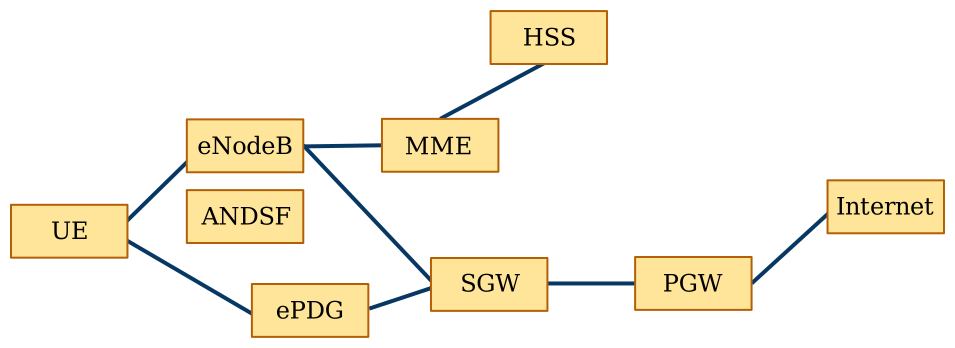
* LTE EPC elements: MME, S-GW, P-GW, HSS. — Jemichel, CC0, via Wikimedia Commons. *
The whole LTE picture, end to end:
UE --air interface--> eNodeB --> [ EPC: MME / S-GW / P-GW / HSS ] --> Internet
The EPC elements at a glance:
| Element | Plane | Role |
|---|---|---|
| MME (Mobility Management Entity) | Control | Authentication, handover, paging, tunnel setup |
| HSS (Home Subscriber Service) | Control | Subscriber database; works with MME to authenticate |
| S-GW (Serving Gateway) | Data | Local anchor; forwards user packets eNodeB ↔ P-GW |
| P-GW (PDN Gateway) | Data | Internet gateway router; NAT; tunnel termination |
Why "all-IP" matters: Unlike GSM/UMTS, which kept a separate circuit-switched domain for voice, the EPC is purely packet-switched — everything, including voice (VoLTE), rides over IP. This is a clean break from the older dual-domain core.
Tip (for explaining the diagram out loud): Walk it left to right — device → over the air to the base station → into the core, where control traffic goes up to the MME (backed by the HSS) and user data goes through the two gateways to the internet. If you can narrate that one sentence, you can talk through the EPC architecture.
Go deeper:
 Main components of E-UTRAN and EPC (ShareTechNote) — a compact, engineer-oriented breakdown that splits the radio side (E-UTRAN: eNodeB) from the core (EPC: MME/S-GW/P-GW/HSS/PCRF) and gives each box its one-line job.
- Evolved Packet Core / System Architecture Evolution (Wikipedia) — the authoritative reference for the EPC elements and how they connect; kept here for its architecture diagrams (carousel).