What is the purpose of a multiple access scheme, and why is it necessary in mobile networks?
Multiple access schemes regulate how multiple users share the same radio medium simultaneously — without them, everyone would interfere with everyone else.
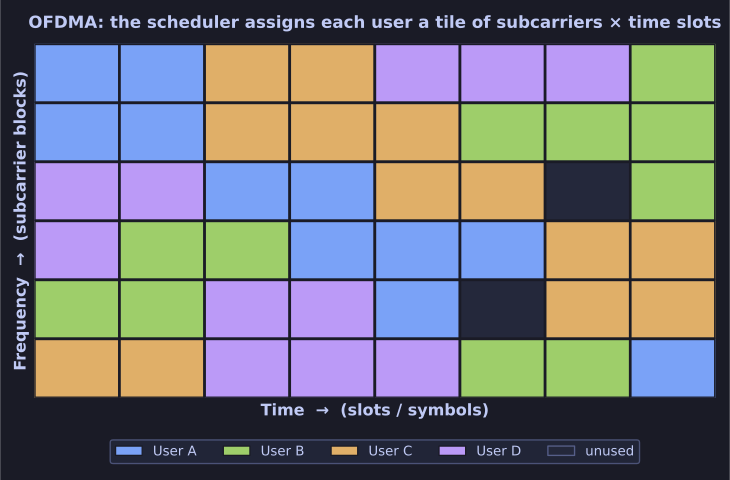
* OFDMA (the 4G/5G scheme) tiles the time-frequency grid, giving each user a block of subcarriers × time slots. *
The fundamental problem:
- Radio spectrum is a shared medium — unlike a cable, you can't give each user their own physical wire
- Multiple users in the same cell need to communicate with the base station at the same time
- Without rules, their signals would collide and become undecodable → interference
The solution: Divide the shared resource (spectrum) along different dimensions:
- Frequency — give each user a different frequency band (FDMA)
- Time — give each user a different time slot (TDMA)
- Code — give each user a different mathematical code (CDMA)
- Space — use directional antennas to separate users spatially (SDMA)
Key fact: Every mobile generation defines its own access scheme. This is one of the most fundamental design choices in a mobile standard:
| Generation | Primary access scheme |
|---|---|
| 1G (analog) | FDMA |
| 2G (GSM) | FDMA/TDMA |
| 3G (UMTS) | CDMA |
| 4G (LTE) | OFDMA |
| 5G (NR) | OFDMA + SDMA (beamforming) |
What is OFDMA? Orthogonal Frequency-Division Multiple Access is the scheme 4G and 5G actually use — think of it as FDMA done right. Instead of a few wide frequency bands, the spectrum is split into thousands of narrow, mathematically orthogonal subcarriers (they don't interfere even though they overlap slightly). The scheduler then hands each user a block of subcarriers and time slots — a tile on a 2-D time-frequency grid (in LTE these tiles are called resource blocks). This is what lets a 5G cell serve many users at once with high efficiency, and it combines naturally with SDMA/beamforming to reuse the same subcarriers for users in different directions.
Go deeper:
 Multiple Access — FDMA/TDMA/CDMA/OFDMA (LTE channel) — walks the frequency-vs-time grid for each scheme, including OFDMA (the 4G/5G choice).
 Channel access method (Wikipedia) — a side-by-side overview of FDMA, TDMA, CDMA, SDMA and OFDMA and how each partitions the medium.
- Orthogonal frequency-division multiple access (Wikipedia) — how 4G/5G assign subsets of orthogonal subcarriers to each user on the time-frequency grid.