Quiz Entry - updated: 2026.07.30
What is the "red zone" in x86-64?
The red zone is a 128-byte area below %rsp that a leaf function may use as scratch space without bothering to adjust the stack pointer.
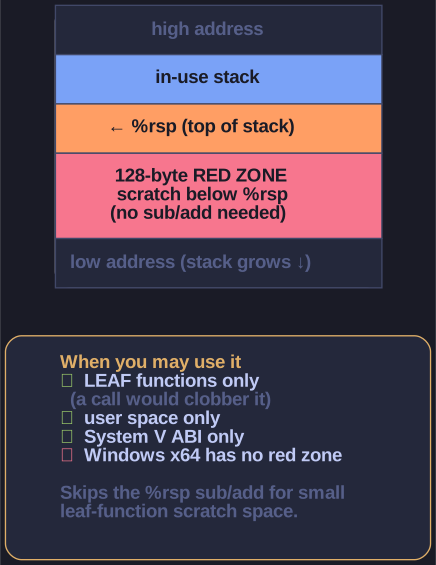
* The 128-byte red zone below %rsp lets a leaf function use scratch space without adjusting %rsp; System V only, user-space leaf functions only. *
It's an ABI optimization: a function that calls nobody else can simply scribble in the 128 bytes just past the top of the stack, skipping the sub/add on %rsp it would otherwise need.
%rsp -> +-----------------+
        | 128-byte        |  ← red zone: usable without sub $N,%rsp
        | red zone        |
        +-----------------+
leaf_func:
    movq %rdi, -8(%rsp)    # use red zone directly — no allocation
    movq %rsi, -16(%rsp)
    ...
    ret
Strict conditions:
- Leaf functions only — a
callwould push a return address right over the red zone. - User space only — kernel code can't use it (interrupts would clobber it).
- System V ABI only — Windows x64 has no red zone.
Important: the red zone is purely an ABI convention, not a hardware feature — the chip knows nothing about it; the compiler and OS just agree that signal handlers and the kernel won't touch those 128 bytes for user leaf code.
Go deeper:
 Red zone (Wikipedia) — defines the 128-byte leaf-function red zone under System V.
- Eli Bendersky — Stack frame layout on x86-64 — the red zone in context within the x86-64 frame.