What problem does EtherChannel solve, and why can't you just add more cables between switches?
EtherChannel solves the problem of STP (Spanning Tree Protocol) blocking redundant links — it bundles multiple physical links into one logical link that STP treats as a single connection.
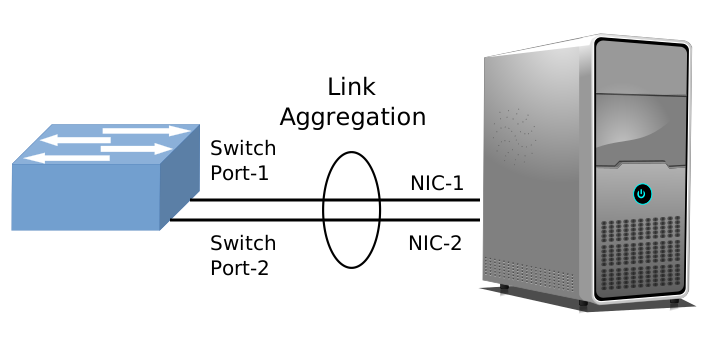
* Several physical links bundled as one logical link. — wdwd, CC BY-SA 4.0, via Wikimedia Commons. *
When you connect multiple cables between two switches to increase bandwidth, STP will block all but one to prevent loops. This means your extra cables sit idle — wasted investment.
EtherChannel (link aggregation) solves this by grouping multiple physical Ethernet links into one logical link. STP sees it as a single connection, so:
- All physical links remain active simultaneously
- You get combined bandwidth (e.g., 4 × 1 Gbps = 4 Gbps logical link)
- Fault tolerance — if one physical link fails, the others keep working
- Load balancing across the bundled links
Tip: Think of EtherChannel as "tricking" STP into seeing one fat pipe instead of multiple thin ones. STP won't block a single link.
Go deeper:
 Link aggregation (Wikipedia) — bandwidth scaling and redundancy as the motivation, and why STP would otherwise block redundant parallel links.