Quiz Entry - updated: 2026.07.30
What three techniques are used to deal with errors caused by poor signal quality in wireless transmission?
CRC error detection codes, redundancy (retransmission), and modulation schemes — each addresses errors at a different layer.
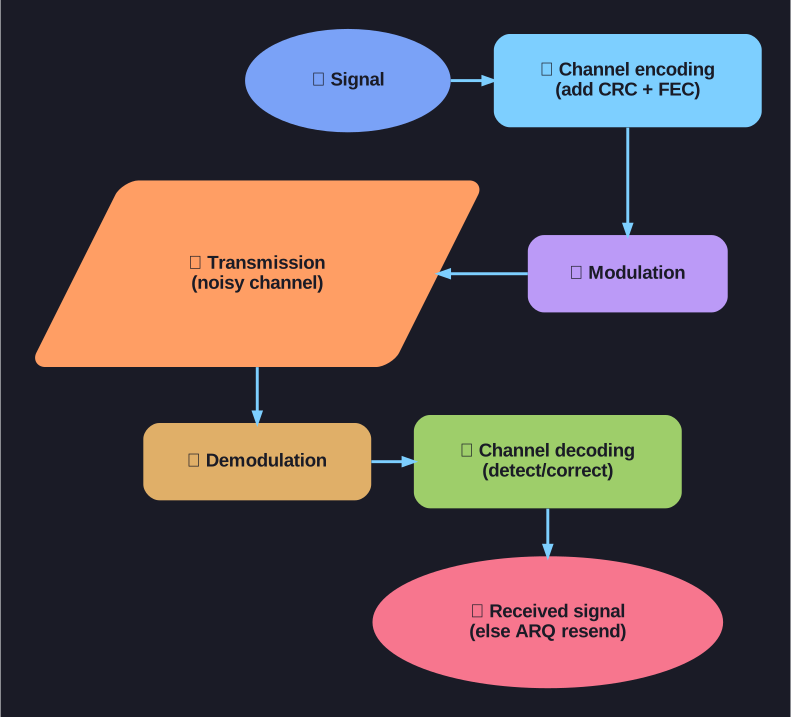
* CRC/FEC encoding, modulation, the noisy channel, decoding, ARQ resend. *
1. CRC (Cyclic Redundancy Check) error detection:
- Adds check bits to transmitted data so the receiver can detect if bits were flipped during transmission
- Doesn't correct errors — just detects them, triggering a retransmission request (ARQ)
2. Redundancy (retransmission):
- Simply send the data again if errors are detected
- Trades bandwidth for reliability — works well when errors are infrequent
- Forward Error Correction (FEC) adds redundant bits proactively so the receiver can fix errors without retransmission
3. Modulation schemes:
- Modulation = encoding digital bits onto an analog carrier wave by varying its amplitude, frequency, or phase
- Different modulation schemes offer different trade-offs between speed and robustness
- The word comes from Latin modulatio = rhythm/measure
The transmit chain: Signal → Channel encoding (add redundancy) → Modulation → Transmission → Demodulation → Channel decoding (error correction) → Received signal
Go deeper:
 Cyclic redundancy check (Wikipedia) — how appended check bits detect (but don't correct) flipped bits, triggering retransmission.
- Forward error correction (Wikipedia) — the proactive redundancy that fixes errors without retransmission, and the reliability-vs-rate trade-off.