Which new features did the 4G/5G standards introduce to cope with traffic growth, and which lever does each pull?
More spectrum (new frequency allocation + OFDMA), more antennas (MIMO, multipoint transmission, relaying), more cells (small cells, home base stations), and integration of other networks like WLAN.
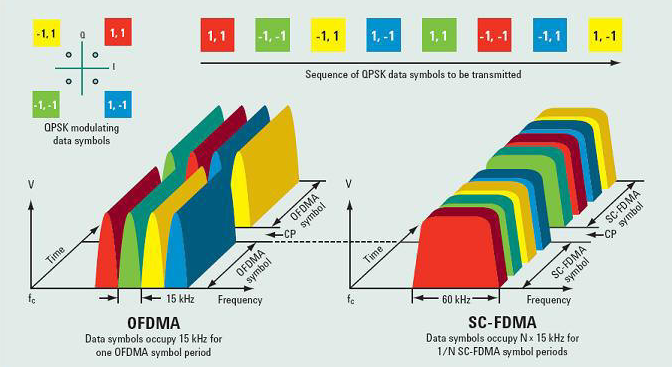
* OFDMA vs SC-FDMA, LTE's new multiplexing. — Oriol.subirana, CC BY-SA 3.0, via Wikimedia Commons. *
Feature map:
| Lever | New features |
|---|---|
| More spectrum | New frequency allocation scheme; new multiplexing technique: OFDMA |
| More antennas | MIMO technology, multipoint transmission and reception, relaying |
| More cells | Small cells, home base stations (Home eNodeBs) |
| Other networks | WLAN integration (offloading traffic to Wi-Fi) |
Why this matters: 4G wasn't one big invention but a coordinated package of improvements. OFDMA replaced CDMA as the access scheme, MIMO multiplied throughput per Hz, small cells multiplied spectrum reuse per area, and Wi-Fi offloading reduced the load on licensed spectrum entirely.
Go deeper:
 OFDM Explained — with MATLAB examples (Waveform Academy) — watch the orthogonal subcarriers overlap without interfering; the visual that makes OFDM/OFDMA finally click.
 4G LTE Modulation: OFDM / OFDMA / SC-FDMA (Electronics Notes) — why LTE uses OFDMA downlink but SC-FDMA uplink (the SC-FDMA low peak-to-average ratio saves handset battery), with resource-block detail Wikipedia skips.
- Orthogonal frequency-division multiple access (Wikipedia) — the canonical reference, kept for its subcarrier/resource-grid diagrams that feed the image carousel.
Tip: Remember the slogan "more spectrum, more antennas, more cells" — almost every modern radio feature falls into one of these three buckets.