Why does a strong correlation between two things not prove that one causes the other?
A correlation only says X and Y move together; it leaves the causal direction — and whether a hidden third factor drives both — completely open.
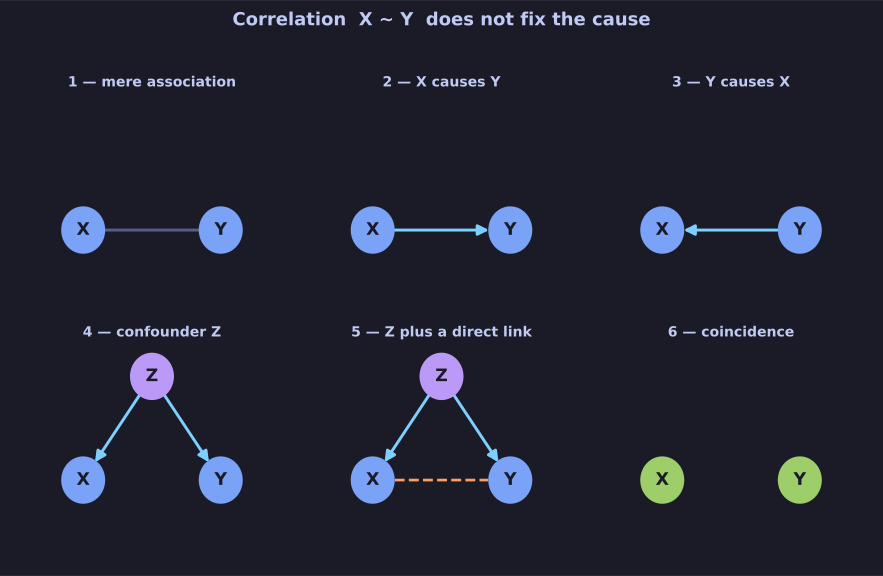
* One correlation, six causal stories — the data alone can't tell them apart. *
A real study once found a striking correlation (r = 0.79, highly significant) between a country's chocolate consumption and its number of Nobel laureates. Eating chocolate obviously doesn't win Nobel Prizes — so what's going on? A single correlation X ~ Y is consistent with several distinct causal structures, and the number alone can't tell them apart:
- Mere association — all you actually observe: X and Y move together, direction unknown. This is the honest default, not a conclusion.
- X → Y — X really causes Y.
- Y → X — the arrow runs the other way.
- Confounder (Z → X, Z → Y) — a hidden third factor drives both, with no direct link between X and Y (here: national wealth raises both chocolate-buying and research funding).
- Confounder plus a direct link — Z drives both and X still has some genuine effect on Y, so the raw correlation blends the two.
- Coincidence — no causal link at all, pure chance — especially likely when you mine many variables for any pair that happens to move together.
So a high correlation coefficient, even with a tiny p-value, establishes only association, never direction or mechanism. A small p-value just means the pattern is unlikely to be pure chance — it says nothing about why the pattern exists.
Tip: Ask three questions of any correlation: Could it run backwards? Could a third factor cause both? Could it just be coincidence among many comparisons?
Go deeper:
 Correlation does not imply causation — worked examples, confounders, and a gallery of absurd spurious correlations.