Why were 4G and 5G needed, and what three factors define the performance of any mobile system?
Mobile data traffic was growing so fast that the industry prepared for a 1000x increase — and since radio resources were already heavily utilized, fundamentally better technology was needed. Performance is defined by three factors: number of antennas, amount of spectrum, and the level of interference.
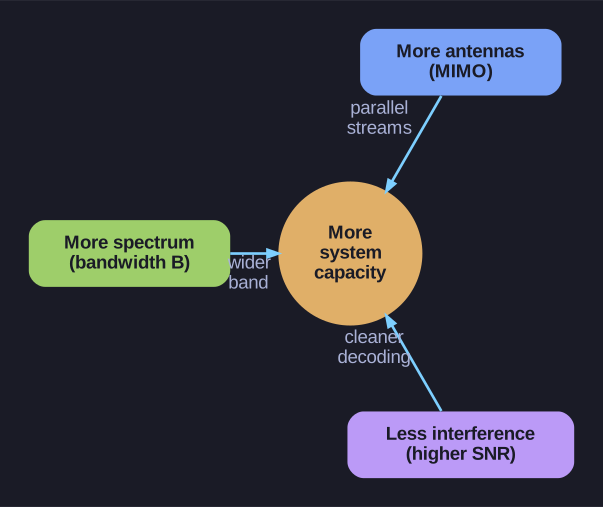
* The three levers feed one outcome — capacity; Shannon's law C = B·log₂(1+SNR) shows why more bandwidth and a higher SNR raise the ceiling, while MIMO multiplies it. *
The traffic explosion:
Smartphones, video streaming, and mobile apps drove exponential growth in data demand. The industry's planning target was a 1000-fold increase in traffic — something incremental tweaks to 3G could never deliver, because the existing radio resources were already squeezed close to their limits.
The three performance levers of any mobile system:
| Factor | Effect |
|---|---|
| Number of antennas | More antennas → more parallel data streams (MIMO) → more throughput |
| Size of the radio spectrum | More frequencies available → more capacity |
| Interference level | Less interference → more data can be decoded correctly |
Every improvement in 4G and 5G attacks at least one of these three levers. This is a useful mental framework: when you hear about any new mobile feature (carrier aggregation, massive MIMO, small cells, beamforming), ask yourself — which of the three levers is it pulling?
Go deeper:
 Shannon–Hartley theorem (Wikipedia) — the capacity law C = B·log₂(1 + SNR) behind two of the three levers: capacity rises with bandwidth B (more spectrum) and with the signal-to-noise ratio (less interference), and MIMO multiplies the whole thing.